
Falls are a major cause of serious injuries in hospitals, industrial sites, care facilities, and public spaces, where fast response can be critical. Traditional monitoring methods, such as human supervision, wearables, or emergency buttons can help, but often fail when individuals are unconscious, alone, or unable to call for help.
AI Fall Detection changes this by using computer vision and real-time video analytics to automatically detect falls and instantly alert responders.
In this article, we’ll look at what fall detection is, how AI video systems work in real time, why it matters across different industries, and the key benefits of this technology.
What is fall detection?
Fall Detection is an AI-powered video analytics capability that automatically recognizes when a person falls to the ground and generates an alert in real time.
Unlike traditional motion detection systems, modern Human Fall Detection platforms do not simply react to movement. Instead, they analyze body posture, motion patterns, and contextual behavior to determine whether a fall actually occurred.
A typical AI Video Monitoring pipeline includes several layers of analysis:
1. Person Detection
The first stage of an AI Video Monitoring pipeline focuses on identifying people within each video frame. Deep learning models trained on large visual datasets analyze the camera feed to distinguish human subjects from surrounding objects, shadows, furniture, or environmental movement. Modern Fall Detection Systems often use real-time object detection architectures capable of tracking multiple individuals simultaneously, even in crowded environments such as hospitals, warehouses, and public facilities.
2. Pose Estimation
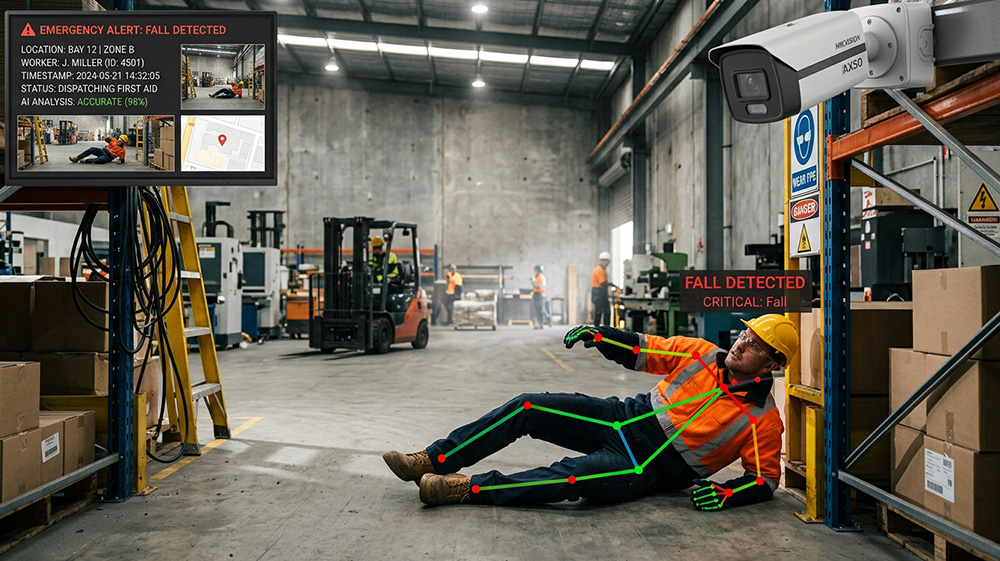
After detecting a person, the system moves to pose estimation. In this stage, the AI maps key body joints including the head, shoulders, elbows, knees, and ankles to create a skeletal representation of the human body. This virtual skeleton allows the system to understand posture and body positioning without relying on facial recognition or personal identity data. Pose estimation plays a critical role in Human Fall Detection because it enables the AI to analyze how the body moves over time rather than simply detecting motion.
3. Motion and Transition Analysis
Once the system understands body posture, it analyzes movement patterns to determine whether a fall may have occurred. AI models examine how quickly a person transitions from a vertical standing position to a horizontal or collapsed posture. The system also evaluates factors such as body velocity, torso angle, movement trajectory, and the speed of descent.
4. Prone Confirmation
The final stage verifies whether the detected event truly represents a dangerous fall. Instead of triggering an alert immediately after sudden movement, the system checks whether the person remains on the ground for a configurable period of time. This helps reduce false alarms caused by temporary movements or intentional actions. If the individual stays motionless or prone beyond the defined threshold, the AI Fall Detection platform generates an alert and sends notifications to responders in real time.
This multi-frame approach is essential for reducing false alarms. For example, bending over, crouching, tying a shoe, or intentionally lying down should not activate a Surveillance Fall Detection alert.
Why fall detection matters?
The importance of Real-Time Fall Detection extends far beyond convenience. In many environments, delayed response to a fall can lead to severe medical complications and operational disruption.
· Healthcare and hospitals
Patient falls remain one of the most common safety incidents in healthcare facilities worldwide. Elderly patients, post-surgery individuals, and patients with mobility limitations face significantly higher risks.
When response times are delayed, complications such as internal bleeding or prolonged immobilization can become life-threatening. AI-powered monitoring enables nurses and emergency staff to respond almost immediately after a fall occurs.
· Senior living and elder care
Older adults are especially vulnerable to falls, particularly in memory care environments where residents may not be able to call for help. Smart Fall Detection systems provide continuous passive monitoring without requiring wearables or user interaction. This allows caregivers to improve resident safety while reducing dependence on manual supervision alone.
· Industrial and construction environments
Falls are among the most dangerous workplace accidents across construction sites, factories, warehouses, and industrial facilities. A worker who falls from height or becomes injured on the floor may be unable to communicate. Safety Monitoring AI systems can rapidly identify worker-down scenarios and notify emergency responders.
· Public infrastructure and campuses
Schools, transportation hubs, correctional facilities, and public buildings increasingly use AI Fall Detection to improve incident response and enhance public safety operations. Modern systems can operate using pose-only analytics without facial recognition, they are also suitable for privacy-sensitive environments.
Benefits of AI surveillance fall detection
Every day, more businesses and public facilities are adopting intelligent video surveillance systems. But what is driving this growing demand, and which advantages have made this technology so widely popular? Below, we take a closer look at some of its key benefits:
· Faster emergency response
One of the biggest advantages of Real-Time Fall Detection is the ability to alert responders within seconds of an incident. Immediate notifications allow medical teams, security personnel, or supervisors to react much faster than traditional monitoring methods. In critical situations, faster response times can significantly reduce the severity of injuries and improve survival outcomes.
· Continuous 24/7 monitoring
Human operators cannot maintain full attention across dozens of surveillance feeds for long periods of time. AI-powered systems continuously analyze camera streams without fatigue, distraction, or loss of focus. This enables reliable around-the-clock monitoring in environments where constant supervision is essential, such as hospitals, factories, warehouses, and care facilities.
· Reduced operational burden
Manual monitoring requires significant staffing resources, especially in large facilities with extensive camera networks. AI Video Monitoring automates the detection process, reducing the workload on security teams, caregivers, and control room operators. Staff can focus on responding to incidents rather than constantly watching live video feeds.
· Lower liability and compliance risk
Falls can create major legal, financial, and regulatory challenges for organizations. A reliable Fall Detection System helps improve incident documentation, response procedures, and workplace safety compliance. In industries with strict health and safety regulations, automated monitoring can also support internal investigations and risk management efforts.
· Improved privacy options
Unlike biometric surveillance systems, pose-based Human Fall Detection can operate without facial recognition or identity tracking. This makes deployment more acceptable in sensitive environments.
· Scalable deployment
Computer Vision Fall Detection platforms integrate with existing surveillance camera infrastructure, making deployment faster and more cost-effective. Organizations can expand monitoring coverage across multiple buildings, campuses, or facilities without requiring a complete hardware replacement.
How Sphere uses AI for intelligent fall detection
Sphere, as one of the most advanced AI video surveillance platforms, uses advanced AI Video Monitoring and computer vision technologies to help organizations improve operational safety and accelerate real-time incident response. Its intelligent video analytics platform continuously analyzes live camera feeds to automatically detect dangerous situations, including human falls, across environments such as hospitals, industrial facilities, warehouses, smart buildings, and public spaces.
Unlike traditional surveillance systems that rely heavily on human operators, Sphere proactively identifies abnormal events the moment they occur, enabling faster response times and more efficient safety operations.
Integration with Existing Security Infrastructure
One of the practical advantages of modern Computer Vision Fall Detection is that it does not require organizations to replace their existing camera systems.
Instead, platforms like Sphere are designed to integrate with:
- IP surveillance cameras
- NVR/VMS systems (Video Management Systems)
- Existing security control rooms
- Alarm and notification systems (SMS, email, mobile apps)
This makes deployment significantly faster and reduces operational costs, allowing organizations to upgrade from passive surveillance to intelligent monitoring without major infrastructure changes.
The future of smart fall detection
As AI surveillance platforms evolve, Smart Fall Detection is becoming part of a larger ecosystem of intelligent safety automation.
Future systems will increasingly combine:
- Edge AI processing
- Behavioral analytics
- Predictive risk detection
- Wearable integration
- Thermal imaging
- Multi-camera scene understanding
Rather than acting only after a fall occurs, next-generation systems may eventually identify elevated fall risk before an incident happens.
For organizations focused on safety, operational efficiency, and rapid emergency response, AI Video Monitoring and Computer Vision Fall Detection are rapidly moving from optional technologies to essential infrastructure.
Conclusion
AI-powered Fall Detection is rapidly becoming a core component of modern safety infrastructure. By combining computer vision, pose estimation, and contextual behavioral analysis, these systems can detect human falls in real time with high accuracy and minimal false alarms.
Platforms like Sphere demonstrate how intelligent video analytics can move beyond traditional surveillance, enabling organizations to respond faster, reduce risk, and create safer environments across healthcare, industrial, and public sectors.
As the technology continues to evolve, Fall Detection will play an increasingly important role in building proactive, always-on safety systems that protect people when it matters most.