
For a small retail store handling a limited number of daily customers, a basic surveillance setup with two or three cameras might seem perfectly sufficient. But when it comes to managing multiple facilities, the situation changes entirely. In these demanding environments, traditional surveillance systems rapidly become a massive operational bottleneck.
This is exactly where we step into the modern era of surveillance, a space where your CCTV cameras do much more than simply record videos. The shift toward AI Video Analysis has completely revolutionized how we interpret visual data. By transforming passive video feeds into dynamic, actionable intelligence, artificial intelligence empowers organizations to optimize their time, drastically reduce overhead costs, and elevate both security and daily operations.
How AI Video Analytics Differs from Traditional Methods
The most fundamental shift from traditional surveillance to intelligent video analytics is the move from manual, reactive monitoring to automated, AI-based surveillance. In the past, video analysis required staff to stare at screens for hours or sift through endless footage after an incident occurred. This approach was highly susceptible to human error and fatigue.
AI Video Analysis leverages machine learning and deep learning to automate this process. They act as tireless digital guards, analyzing live feeds in real time to flag the moments that actually matter.
| Feature | Traditional Video Surveillance | AI-Powered Video Analytics |
| Core Approach | Reactive (post-incident manual review) | Proactive (real-time automated detection) |
| Monitoring | Labor-intensive, prone to human fatigue | 24/7 continuous and highly accurate |
| Infrastructure | Requires heavy on-site hardware (DVRs/NVRs) | Cloud-first, highly scalable, and centralized |
| Searchability | Time-consuming “needle in a haystack” search | Instant natural language and metadata search |
| Cost Impact | High ongoing labor and maintenance costs | Lower total cost of ownership through automation |
Benefits of AI Video Analytics
By turning standard security cameras into intelligent sensors, AI video analytics delivers a rapid return on investment. The technology provides measurable value that extends far beyond traditional security:
- Drastic Cost Reductions: Transitioning to a cloud-based platform eliminates the need for expensive on-site servers and continuous hardware maintenance. However, the cost reductions associated with AI video analytics extend far beyond infrastructure. This technology also slashes the labor costs associated with round-the-clock manual monitoring.
- Instant Incident Response: Real-time alerts dramatically shorten response times. Instead of discovering a breach hours later, security teams are notified the second an unauthorized person crosses a virtual perimeter, allowing them to prevent incidents rather than just document them.
- Fewer False Alarms: Because adaptive AI learns the specific patterns of its environment, it easily distinguishes between a genuine threat and a harmless trigger (like moving shadows or wildlife), saving operators valuable time.
- Maximized Operational Efficiency: AI Video Analysis generates actionable data. Organizations can analyze traffic flows to resolve bottlenecks, ensure safety compliance, and reallocate their human workforce to more strategic, higher-value tasks.
- Seamless Scalability: Cloud architectures allow businesses to manage hundreds of cameras across multiple geographic locations from a single, unified dashboard without complex infrastructure overhauls.
How does AI video analytics work?
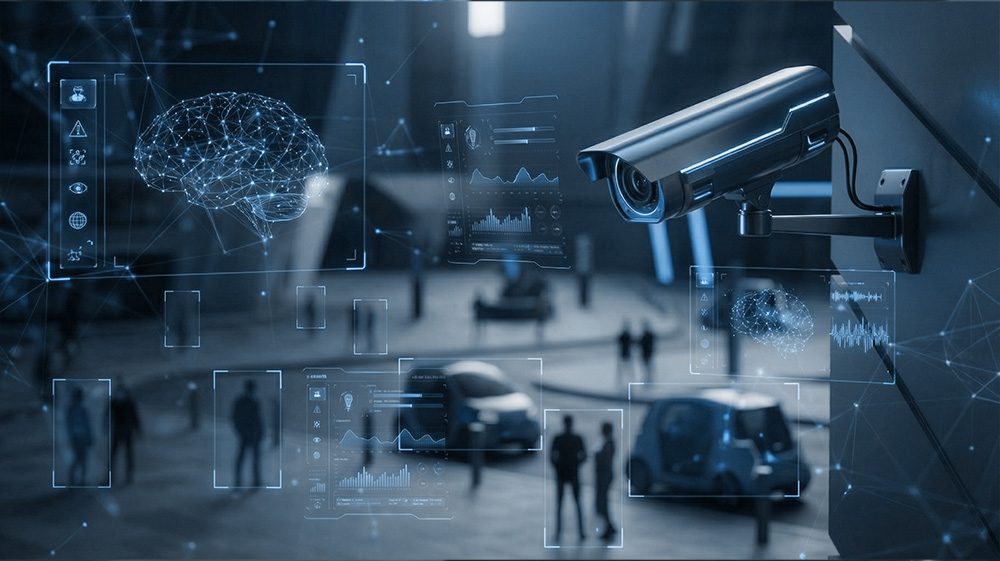
True AI Video Analysis relies on sophisticated computer vision and neural networks to see, understand, and learn. The process happens in milliseconds:
- Data Ingestion: The system captures continuous video feeds from integrated cameras across the network.
- Frame Analysis: The software breaks the video down into individual frames, reading raw pixels to analyze the visual data.
- Feature Identification: Using deep learning algorithms, the AI detects and classifies specific objects within the frame, such as people, vehicles, or specialized equipment.
- Metadata Extraction: Key information from these features is converted into metadata, capturing details like object size, speed, color, trajectory, and other relevant attributes.
- Behavior and Context Recognition: The system tracks these objects through space and time, evaluating their actions against predefined rules (e.g., loitering, moving in the wrong direction, or entering restricted zones).
- Real-Time Alerts: If a threshold is crossed or an anomaly is detected, the system instantly extracts the metadata and sends an automated alert to the designated personnel.
- Adaptive Learning: As the models process more data, they continuously refine their understanding of what constitutes “normal” behavior for that specific environment, improving accuracy over time.
What industries benefit most from adaptive AI video intelligence
Video Analysis with Artificial Intelligence is highly versatile, as AI models can be trained to detect industry-specific patterns, making the applications of this technology vast and adaptable. In the following, we look at the applications of AI Video Analytics in various industries.
- Manufacturing and Logistics
Industrial environments use AI Video Analysis to monitor production lines for quality control and automatically detect product defects. It also ensures strict workplace safety compliance, such as verifying that workers are wearing hard hats, and helps optimize warehouse traffic to prevent logistical bottlenecks.
- Retail and E-Commerce
Retailers leverage video intelligence to map customer journeys. By analyzing foot traffic patterns, dwell times, and heat maps, store managers can optimize floor layouts and product placements. Additionally, automated object detection acts as a powerful loss prevention tool by flagging suspicious behavior in real time.
- Healthcare
Hospitals use adaptive AI to enhance patient safety and streamline facility management. AI Video Analysis can provide real-time fall detection for vulnerable patients, monitor secure areas for unauthorized access, and help administrators optimize emergency room workflows based on patient influx.
- Smart Cities and Transportation
Urban planners and traffic managers rely on video analytics to monitor congestion, optimize traffic light sequencing, and enforce road safety. The technology also powers automatic license plate recognition (ALPR) and helps public transport hubs manage crowding safely.
- Education
For large, multi-site school districts or university campuses, AI surveillance provides robust security without creating an oppressive atmosphere. It quickly identifies unauthorized visitors, manages access control, and allows security teams to search for specific events across campus in seconds.
Conclusion
In the end, we see that AI Video Analysis is no longer a luxury or optional tool—it has become an integral part of control rooms across industries. By moving beyond the old “record and respond” model and embracing active, adaptive intelligence, businesses can overcome the logistical challenges of managing multiple sites. Focusing on optimizing video analysis helps organizations streamline operations, enhance security, and make faster, data-driven decisions.
This technology transforms your network into a powerful engine for growth. It minimizes human error, slashes overhead costs, and provides deep operational insights that were previously hidden in hours of unreviewed footage.