
Introduction
Almost all of us have experienced standing in a long queue whether at a retail checkout, a bank, or a service center. What we often overlook is that the problem is not just a few minutes of waiting. Especially from a business perspective, the impact is much deeper. According to several surveys, around 70% of people feel emotions such as frustration, boredom, and irritation while waiting in line. On the other hand, approximately 61% of customers leave the queue before it is their turn.
This means a significant portion of customers are unwilling to complete the waiting process.
For businesses, this is not only a matter of customer satisfaction—it directly affects revenue. When a customer abandons a purchase or leaves a service center due to long queues, it results in a lost sales opportunity. Now imagine this happening daily for dozens or even hundreds of customers. The outcome is reduced sales, lower customer satisfaction, and damage to brand reputation.
Fortunately, modern Queue Management Systems powered by artificial intelligence can address this issue. Using surveillance cameras and AI Video Analytics Queue Management, these systems can automatically monitor queue conditions and provide valuable insights to decision-makers. In this article, we will explore the concept of a smart and intelligent Queue Management System.
What is a Queue Management System?
A Queue Management System is an intelligent solution designed to control and manage customer queues. It helps businesses reduce waiting times and deliver faster, more organized services. In simple terms, it manages the flow of customer entry, waiting, and service delivery to prevent congestion and long lines.
Traditional methods required staff or managers to manually monitor queues. However, in a modern Smart Queue Management System, this process is automated using technologies such as artificial intelligence, computer vision, and video analytics.
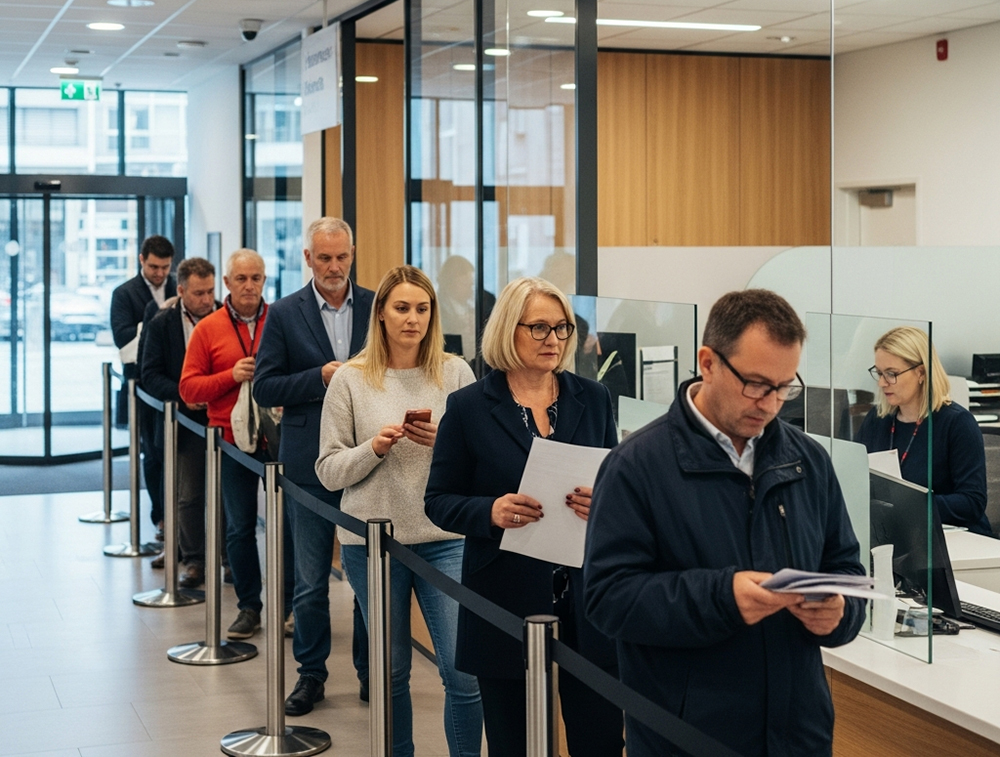
These systems can detect the number of people in a queue, calculate waiting times, and automatically send alerts when a specific area becomes overcrowded. This is where AI Queue Management and Queue Detection Systems play a crucial role in improving operational efficiency.
With Intelligent Queue Monitoring and AI-based Queue Monitoring, businesses gain real-time visibility into customer flow. In addition, Customer Queue Analytics enables data-driven decisions that improve service quality and reduce waiting times.
Overall, Queue Management with Computer Vision and Real-time Queue Detection technologies are transforming traditional service environments into smart, efficient, and customer-friendly systems, including modern Retail Queue Management Systems and Waiting Time Monitoring Systems.
How AI-Based Queue Management Systems Work
AI-powered Queue Management System solutions typically operate using existing surveillance cameras in the environment, and in most cases, there is no need to install complex hardware or modify the current infrastructure. These systems capture video streams from cameras and, using computer vision algorithms and Video Analytics Queue Management, continuously analyze the state of queues in real time.
In the first stage, the Queue Detection System identifies and counts individuals present within the queue area. Then, key metrics such as the number of people in line, queue movement speed, crowd density, and estimated waiting time are extracted. These data points are analyzed in real time to provide an accurate understanding of the current queue conditions.
After data processing, the Smart Queue Management System compares the situation with predefined thresholds. For example, if the number of people exceeds a certain limit or the waiting time goes beyond an acceptable standard, the system classifies the situation as overcrowding. In such cases, alerts are automatically sent to managers or staff so they can take immediate action—such as opening an additional checkout counter, reallocating staff to busy areas, or redirecting customers to less crowded queues.
One of the most important capabilities of AI-based Queue Management and Intelligent Queue Monitoring is that it is not limited to detecting the current situation. By storing and analyzing historical data, these systems can also identify behavioral patterns. This enables Customer Queue Analytics to predict peak hours and helps businesses proactively manage resources before congestion occurs.
In fact, the combination of Queue Management with Computer Vision and Real-time Queue Detection allows businesses to move beyond simply reacting to long lines. Instead, they can prevent queue formation altogether and deliver a significantly improved customer experience through AI Queue Management and advanced Queue Detection in Retail Stores.
Benefits of AI-Based Queue Management Systems
Today, businesses can no longer rely solely on increasing the number of checkout counters or hiring more staff to control congestion. Customers expect faster service and shorter waiting times. As a result, AI Queue Management has become one of the most widely adopted solutions in retail stores, banks, healthcare centers, and other service environments. These systems use image analysis and real-time data processing to help businesses better manage queues and improve overall customer experience.
• Reducing customer waiting time
The most important benefit of Queue Management Systems is reducing waiting time. These systems detect congestion early through Real-time Queue Detection and send alerts to staff so that necessary actions can be taken before queues become too long.
• Increasing customer satisfaction
No one enjoys waiting in long lines. When customers receive services faster through a Smart Queue Management System, they have a better experience and are more likely to return to the business.
• Optimizing workforce allocation
Using insights from Customer Queue Analytics, managers can adjust staffing levels according to customer traffic. This helps prevent both staff shortages and overstaffing, improving operational balance.
• Better crowd and congestion control
Intelligent Queue Monitoring systems can detect sudden increases in customer volume in real time and send alerts before long queues form, enabling proactive crowd management.
• Predicting peak hours
One of the key features of AI-based Queue Monitoring is analyzing historical data to predict peak visiting hours. This helps businesses plan resources and staffing more effectively in advance.
• Access to accurate and actionable data
Managers can review detailed metrics such as average waiting time, number of people in line, peak hours, and queue abandonment rates. This data enables more informed decision-making through Queue Detection Systems and analytics dashboards.
• Reducing lost sales
In retail environments, long queues are one of the main reasons customers abandon purchases. A Retail Queue Management System reduces waiting time and lowers the likelihood of cart abandonment, directly improving revenue.
• Using existing infrastructure
Many AI Video Surveillance for Retail solutions run on existing CCTV infrastructure. This means businesses can implement advanced queue monitoring without investing in new hardware.
• Improving operational efficiency
By automating Real-time Queue Detection and Waiting Time Monitoring System functions, staff spend less time managing queues and more time focusing on customer service, resulting in higher overall efficiency.
Challenges of Queue Detection Systems
Despite all the advantages of Queue Detection Systems and AI Queue Management solutions, these technologies are not without challenges. The accuracy and performance of these systems largely depend on environmental conditions, data quality, and implementation methods. Therefore, businesses must be aware of potential limitations before adopting these solutions.
• Heavy crowding and overlapping individuals
In highly crowded environments, accurately detecting and separating individuals can become difficult. This can negatively affect the accuracy of AI Video Analytics Queue Management and overall analysis results.
• Lighting changes and environmental conditions
Low light, excessive brightness, reflections from surfaces, or sudden changes in illumination can impact the performance of computer vision systems and reduce the reliability of Intelligent Queue Monitoring.
• Improper camera angles
If cameras are not installed at suitable angles, parts of the queue may remain outside the field of view. This increases the risk of errors in Real-time Queue Detection and customer flow analysis.
• Different definitions of queues across environments
Queue Management Systems do not operate the same way in all settings. A queue in a retail store, bank, or airport may follow different behavioral patterns and structures, requiring customized configurations for each environment.
• Need for model training and optimization
To achieve optimal performance, AI-based Queue Monitoring models must be trained according to each business environment and continuously optimized over time to maintain accuracy.
• Privacy concerns
The use of AI Video Surveillance for Retail and video-based analytics may raise concerns regarding personal privacy. Therefore, compliance with data protection regulations and privacy standards is essential.
• Need for sufficient computing infrastructure
Real-time video processing and analysis require significant computational resources, especially in large environments with multiple cameras supporting Crowd and Queue Management systems.
• Implementation and maintenance costs
Although many systems use existing CCTV infrastructure, deployment, customization, and maintenance still require initial investment and ongoing technical support for Smart Queue Management System solutions.
However, rapid advances in artificial intelligence and computer vision have significantly reduced many of these challenges. As a result, the adoption of Queue Management with Computer Vision continues to grow rapidly in retail stores, service centers, and other high-traffic environments.
The Future of AI-Based Queue Management Systems
AI Queue Management systems are still in the early stages of their evolution, and with continuous advancements in technology, their capabilities are expanding every day. While today these systems can detect queue length, waiting time, and congestion levels, in the future they will play a much more significant role in managing overall customer experience. In fact, the goal will no longer be limited to managing queues, but rather to predicting customer needs and optimizing the entire service delivery process.
With the development of artificial intelligence and computer vision, Smart Queue Management System solutions will be able to analyze customer behavior patterns with much higher accuracy. They will even be capable of predicting congestion before long queues are formed. This will enable businesses to proactively allocate resources and staff in the right place at the right time, preventing operational bottlenecks before they occur.
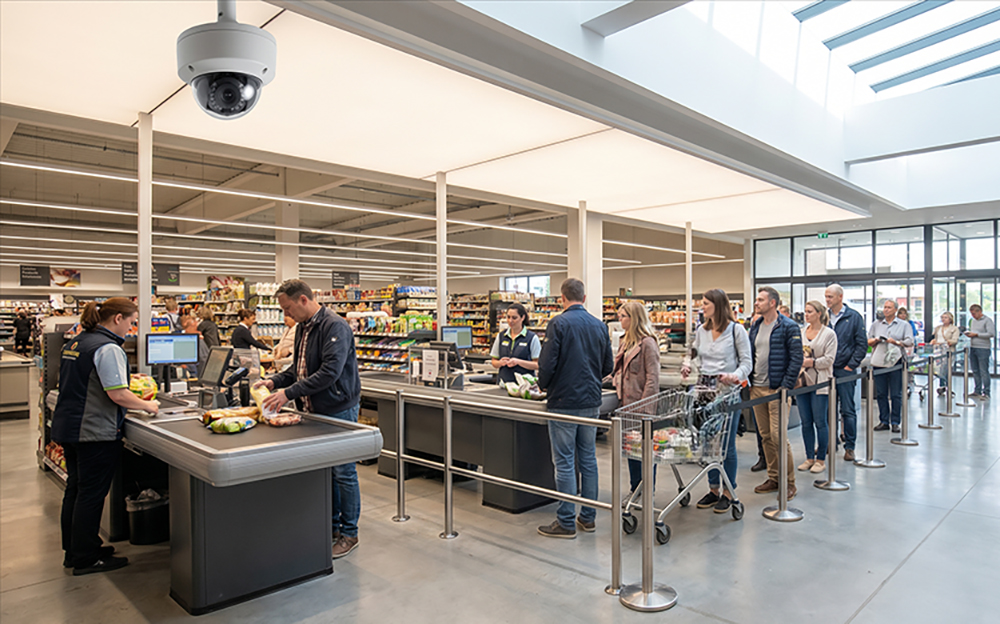
On the other hand, Queue Management Systems are expected to become more deeply integrated with other enterprise systems. For example, insights generated through Customer Queue Analytics can be directly used in workforce planning, sales management, customer behavior analysis, and even store layout design. This level of integration ensures that decision-making becomes increasingly data-driven and precise.
Beyond queue management, platforms such as Sphere represent a new generation of intelligent video surveillance systems that can support multiple use cases. Sphere is not limited to Queue Management; instead, it provides a unified AI Video Analytics infrastructure that can be applied to scenarios such as crowd monitoring, security surveillance, retail analytics, and operational optimization. Within this framework, Queue Detection Systems and Real-time Queue Detection are only one of many applications enabled by the platform. This flexibility allows businesses to deploy Intelligent Queue Monitoring alongside other AI-driven insights, without relying on separate systems for each use case.
Moreover, with improvements in computer vision models, limitations such as detecting individuals in highly crowded environments or under complex lighting conditions will be significantly reduced. As a result, businesses will be able to deploy Queue Detection Systems with greater confidence across retail stores, banks, airports, healthcare centers, and other high-traffic environments.
Ultimately, the future of AI-based Queue Monitoring points toward faster services, smarter decision-making, and enhanced customer experiences. As this technology continues to evolve, organizations will gain deeper visibility into customer behavior and will be able to optimize their services based on real needs leading to higher customer satisfaction and improved operational efficiency.